
HYXiPOWER HS vs HT Series: Decoding the Model Numbers
If you've been sent a solar-plus-battery quote with a HYXiPOWER inverter on it, you've probably noticed the model number isn't just a kW figure. It ends in a two-letter suffix — usually HS or HT — and that suffix is doing more work than most homeowners realise. It's not a size code or a version number. It tells you which electricity supply the inverter is built to connect to, and it quietly determines what the rest of your system is allowed to look like.
This guide breaks down exactly what HYXiPOWER HS vs HT means on a quote, so you can check whether the model on your paperwork actually matches your home before you sign anything.
What the HYXiPOWER Model Number Suffix Actually Means
HYXiPOWER's hybrid inverter range is split into two structurally different families, and the suffix is the tell:
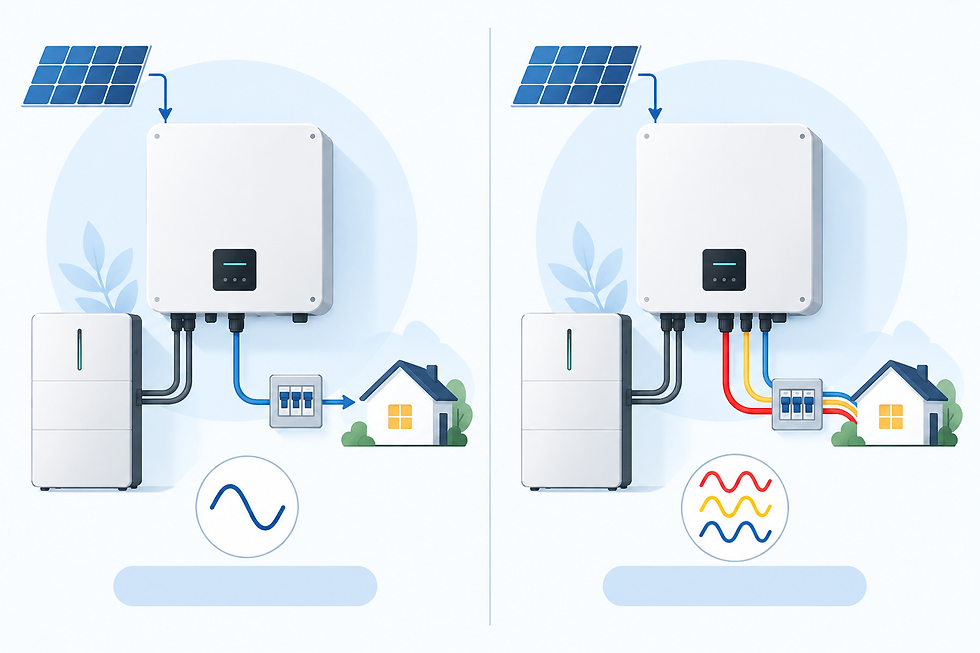
HS = Hybrid, Single-phase
HT = Hybrid, Three-phase
The number before the letters (3K, 5K, 8K, 10K, and so on) is the inverter's rated output in kilowatts. The letters after it are the phase configuration — a hardware distinction, not a performance tier. An HS unit cannot be swapped for an HT unit of the same kW rating, because they're wired for different incoming electricity supplies. Confusing the two is the single most common reason a quoted inverter turns out to be the wrong fit once an electrician actually looks at the switchboard.
HYXiPOWER HS vs HT Series
HYXiPOWER HS Series: Single-Phase Hybrid Inverters
The HS series (spanning the H3K/3K6/4K/4K6/5K/6K/8K-HS lineup) is built for the single-phase electricity supply found in most standalone Australian homes. It handles solar generation, battery charging and discharging, and backup switching in one unit, with a compact 30-minute installation footprint that installers regularly point to as a selling point on straightforward jobs.
On spec, the HS series supports a maximum PV array input of 10,000W across two MPPT trackers (80–560V range, 600V absolute maximum), and a battery voltage window of 80–490V at up to 35A. Grid-to-backup switching happens in under 10 milliseconds — fast enough that most sensitive electronics won't register the changeover during an outage. The series also carries a 150% turbo backup surge rating (roughly 7,500W for 10 seconds on the 5K model), which is what lets it start a fridge compressor or a bore pump without tripping. Protection-wise, it's rated IP65 with C4-level salt-spray resistance, plus AFCI arc-fault detection and rapid shutdown (RSD) — both relevant if the installation is coastal or on a metal-roof home, which describes a large share of the Australian market.
HYXiPOWER HT Series: Three-Phase Hybrid Inverters
The HT series (H5K/6K/8K/10K/12K-HT) is the equivalent product line for homes on a three-phase electricity connection — typically larger homes, homes with ducted air conditioning or a pool, and newer builds where the developer wired in three-phase power from the start.
Structurally, the HT series shares its 150–600V battery voltage range and sub-10ms switching speed across the whole line, along with a 40A max charge/discharge current — noticeably higher than the HS series' 35A ceiling, which is part of why HT-paired battery banks tend to recharge faster after a cloudy stretch. Efficiency peaks at 98.6%. Comparing the two ends of the range shows how the family scales: the entry-level HYX-H5K-HT delivers 5,000W nominal output with a 10,000W max PV array input and a 7,500W backup surge, while the HYX-H10K-HT doubles that across the board — 10,000W nominal, 20,000W max PV array, and a 15,000W 10-second backup peak. Both ends of the range share the same 34kg, 542×478×186mm chassis and IP65/C4 rating as the HS series, so the physical footprint on the wall doesn't change — only what's happening electrically behind it.
Spec | HYX-H5K-HS (single-phase) | HYX-H5K-HT (three-phase) |
Phase type | Single-phase | Three-phase |
Nominal output | 5,000W | 5,000W |
Max PV array input | 10,000W | 10,000W |
Max charge/discharge current | 35A | 40A |
Backup surge (10s) | ~7,500W (150%) | 7,500W |
Switching speed | <10ms | <10ms |
Enclosure rating | IP65, C4 salt-spray | IP65, C4 salt-spray |
Why It Matters When You're Comparing Quotes
This is the part thin comparison sites tend to skip: the HS/HT letter isn't a preference — it's dictated by your switchboard, not your rooftop or your budget. If your home has a single-phase supply and a quote lists an HT-suffix inverter (or vice versa), that's either a typo worth querying or a sign the quote was templated rather than built for your property. It's also worth checking that the battery capacity and stack size quoted alongside the inverter are actually compatible with the max charge/discharge current of the series you've been quoted — an HS-paired system maxes out its charging rate a little earlier than an HT-paired one, which can matter if you're chasing a full battery top-up in a short winter sun window. When a quote is clear about both the letter and the number, it's usually a sign the person who built it actually checked your meter box rather than pulling a generic package off a shelf.
Why Solar Panels and Battery Storage Make Sense in Australia
Rooftop Solar Uptake Keeps Climbing
Australia's rooftop solar fleet keeps setting records. The Clean Energy Regulator's Q2 2026 Quarterly Carbon Market Report recorded a record 1GW of rooftop solar capacity installed in a single quarter, and as at 23 July 2026 there were 4.469 million rooftop solar systems installed nationally — roughly 41% of Australian homes.
Batteries Are Catching Up Fast
Home battery installs are following the same trajectory. 2025 saw more than 193,000 home battery installs (around 4.6GWh of capacity), and 2026 is forecast to reach 8–12GWh across roughly 350,000–520,000 installs, driven largely by the federal Cheaper Home Batteries Program's tiered incentive structure.
Electricity Pricing Is Rewarding Midday Solar Use
The Australian Energy Regulator's 2026–27 Default Market Offer, finalised on 26 May 2026 and effective 1 July 2026, cut standing-offer electricity prices across every regulated region and introduced the Solar Sharer Offer — a new opt-in tariff giving households with smart meters three hours of free grid electricity in the middle of the day (11am–2pm in NSW and South East Queensland, 12pm–3pm in South Australia). It's a structural incentive to either use solar directly during the day or store the surplus in a battery for the evening peak, which is exactly the job a correctly matched hybrid inverter and battery stack are built to do.
Getting the Right Series for Your Home
Whether the right fit for your property is an HS-series single-phase inverter or an HT-series three-phase unit isn't something to guess from a brochure — it depends on your existing switchboard, your roof's PV oversizing headroom, and how much backup power you actually want during an outage. HYXiPOWER (the manufacturer behind both series) has been refining this range specifically for markets like Australia; you can read more about the company and its Australian track record on our About HYXI page. If you'd like a system sized against your actual meter box and roof rather than a generic package, request a free, no-obligation quote and we'll confirm which series and stack size suit your home. And before you commit to a number, it's worth checking what you're eligible for — our 2026 Rebate Guide breaks down the current federal and state incentives available for solar and battery installations.
Why Choose AU Solar Mate?
At AU Solar Mate, we handle the entire solar battery installation process — from system design to installation and support.
Our services include:
Battery sizing assessments
Hybrid inverter recommendations
Backup power setup
Compliance management
Monitoring configuration
You work directly with experienced technical specialists — not sales teams.
📞 Call: +61 1800 508 922
🌐 Website: AU Solar Mate
✉️ Email: sales@ausolarmate.com.au


Comments